INTERSTELLAR SURVEY AUTHORITY · RECRUITMENT DIVISION

Greetings, agent.
Assignment: Earth.

The local fauna remains undocumented. One thousand one hundred and thirty-five species are on file and the mainframe is empty. Point the standard-issue scanner at something living and it becomes a specimen record only you hold — your photo, your coordinates, your serial number.

1,135SPECIES ON FILE
6CLASSIFICATIONS
35CLEARANCE GRADES
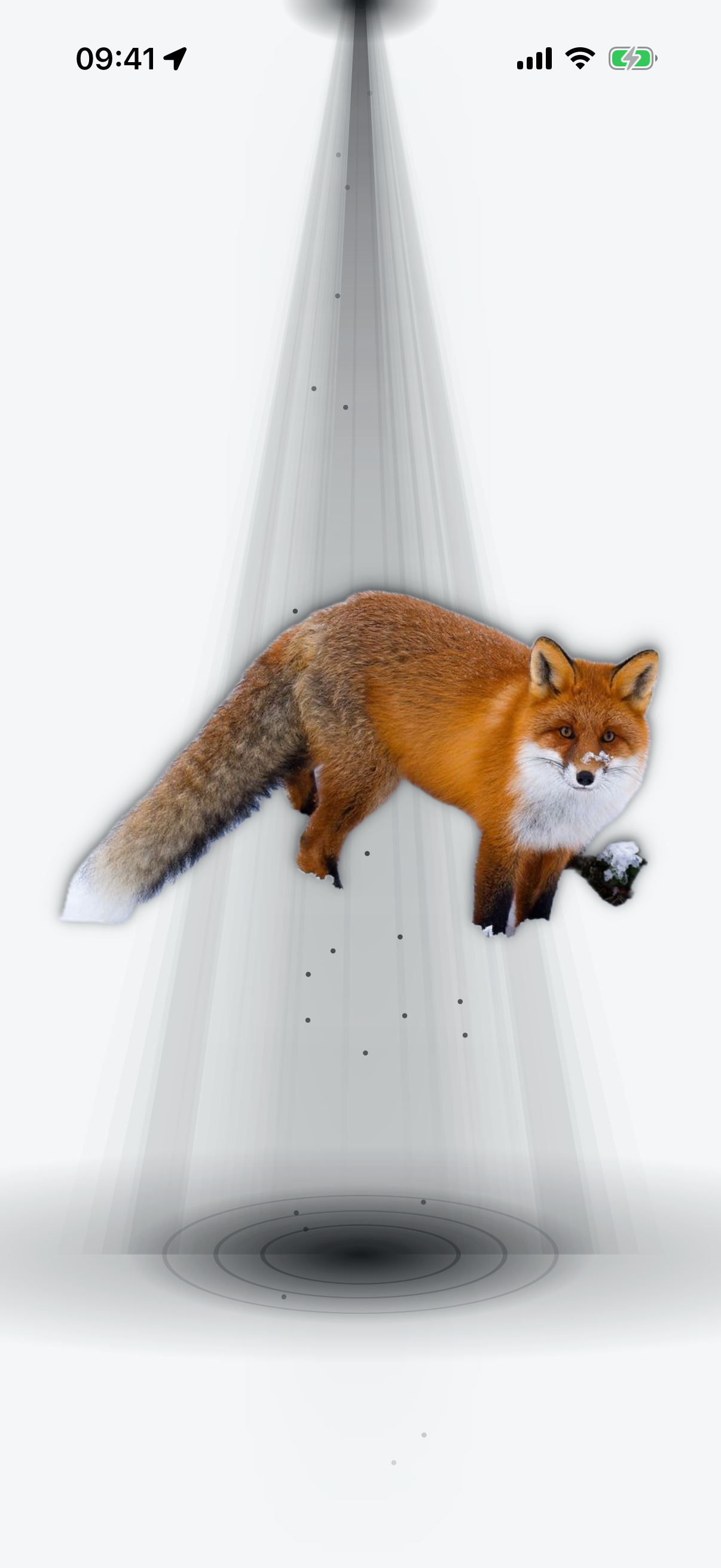
A red fox mid-abduction, lifted in the ink beam with the landing pool burning beneath it
The mainframe grid: logged specimens as cut-outs among NO RECORD silhouettes

CLASSIFICATION

A pigeon is not a peregrine.

Every species on file carries a classification, and the classification is what makes a walk worth taking. Common fauna is abundant and dull. A precious few are Secret — and those the archive will not even show you the shape of.

Common

Abundant. Genuinely everywhere.

400 ON FILE

Uncommon

Worth stopping for.

280 ON FILE

Rare

A good day's work.

180 ON FILE

Epic

A commendable week.

90 ON FILE

Legendary

A season's pursuit.

36 ON FILE

Secret

No record. You'll know.

14 ON FILE

01 — THE SCAN

Point. Capture. The mainframe handles the rest.

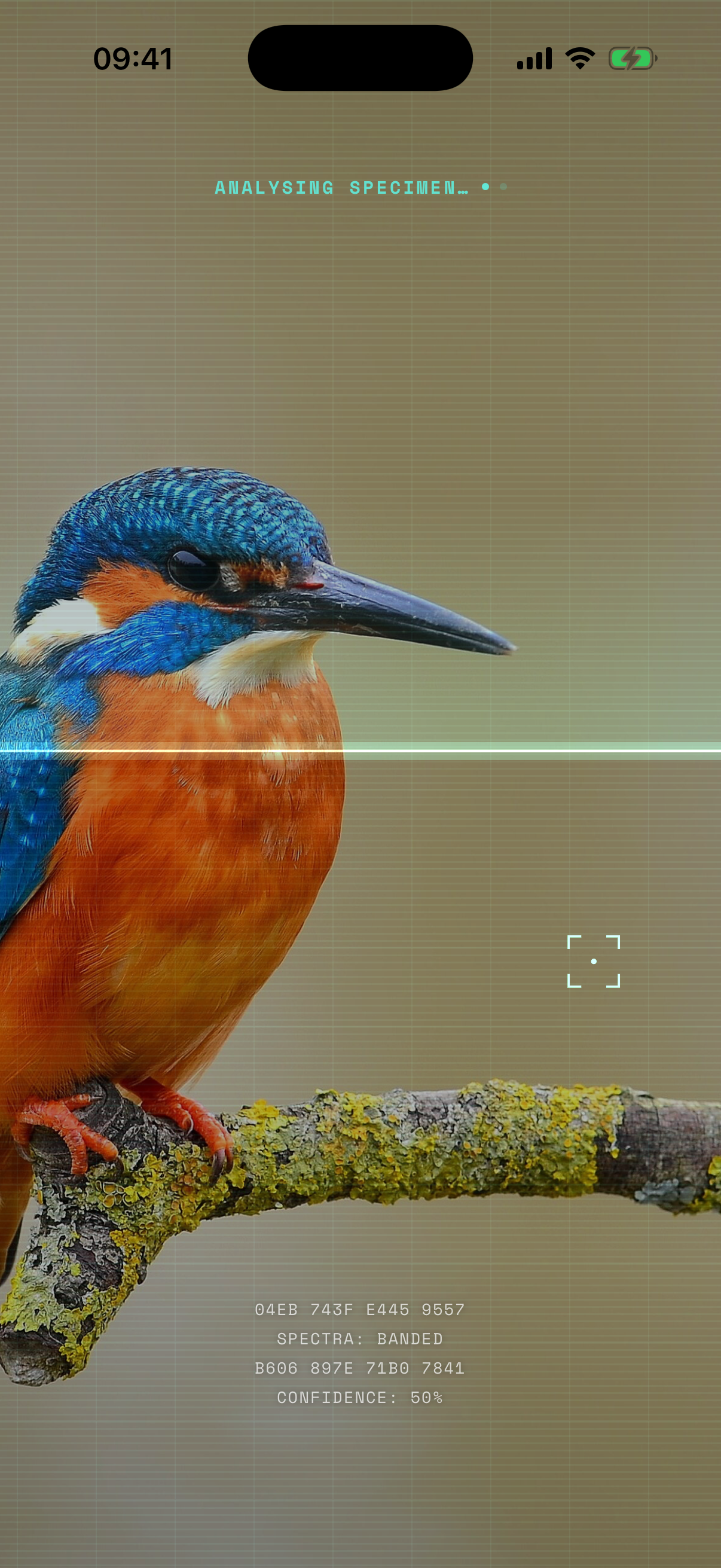
Raise the scanner, frame the animal, fire. The instrument reads the capture, cross-references eleven hundred records, and returns a classification — and the specimen is lifted out of the frame in front of you.

  • The subject is cut from its background on device. The animal is lifted off the photograph by the phone itself and set into the record.
  • It has to be alive and it has to be there. Photographs of screens, of prints and of yesterday are all refused — and a specimen behind zoo glass pays a fraction of the DATA.
  • When two species are genuinely close, it asks. The instrument shows you the candidates rather than guessing and being confidently wrong.
  • A confidence reading that admits doubt. Identification takes as long as it takes, and the readout says so.
ANALYSING SPECIMEN — the instrument sweeping a photographed kingfisher, morphology parsing and a confidence readout below

02 — THE RECORD

One record per specimen, not one per species.

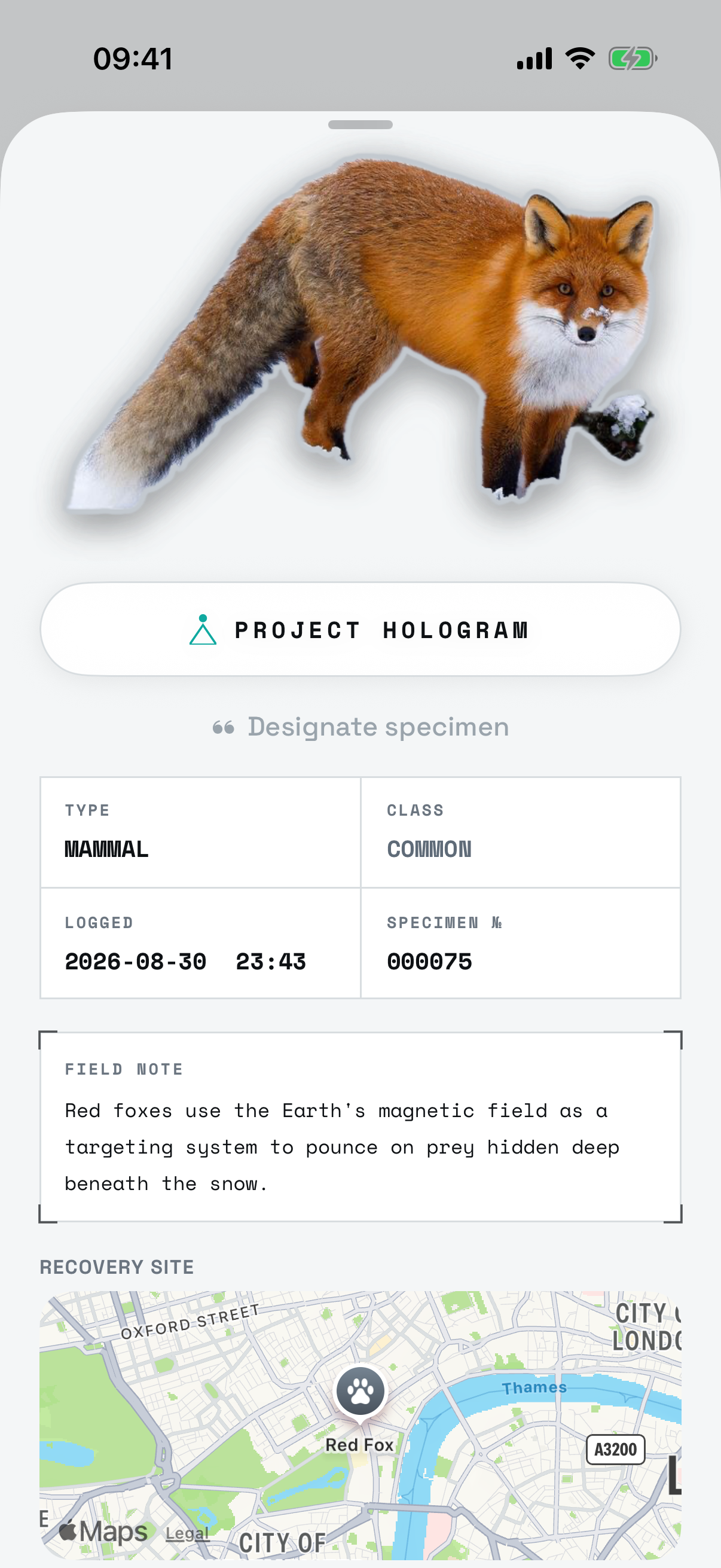
What comes back is the specimen itself — cut from your photograph, wearing its classification at the edge — with the date, the territory, and a serial number that is never reissued to anyone.

  • Log the same species twice and you hold two records. № 000431 says this was the 431st time any agent logged that species. It stands whether or not you keep the record.
  • Real readings. Mass, velocity, threat level and DATA, plus a field note about the animal you probably didn't know.
  • Project the hologram. Any record stands its specimen on the projector — cut from the exact animal you logged, lit by its classification, or shown in its true colour.
  • Yours to name, transmit, or jettison. Nickname a record, share it, or release it back to the survey.
The Red Fox's specimen record: the cut-out at the top, the PROJECT HOLOGRAM control beneath it, then type, class, date and serial number, the field note and the recovery site

03 — THE MAINFRAME

A slot for every species, and no record in most of them.

The full catalogue is open from your first day — but nothing you haven't found will tell you its name. An empty slot gives you a silhouette and a number, and leaves the rest to you.

  • Built on real occurrence data. The catalogue comes from GBIF records, not from a wishlist.
  • A silhouette is the whole hint. Open a locked slot and it still won't name the animal — just its number, its kind, and NO RECORD where the name goes.
  • Classification stays withheld too. You're never told how hard something is to find, because that would tell you how hard to look.
  • The Secrets don't even show a shape. No silhouette, no number, no lock. You find them by finding them.
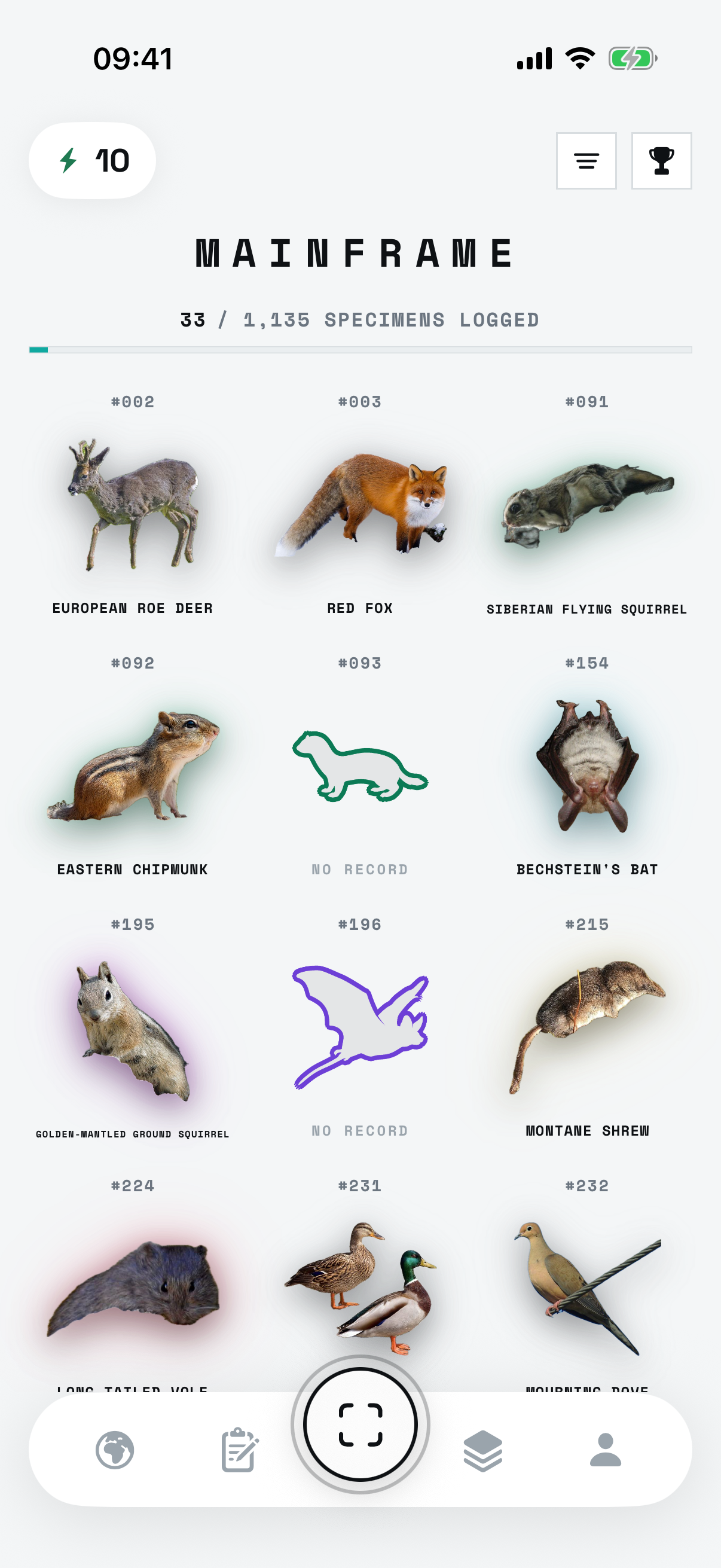
The mainframe grid: logged specimens edged in their classification colour, unlogged ones showing NO RECORD

04 — THE SECTOR

Your year, plotted.

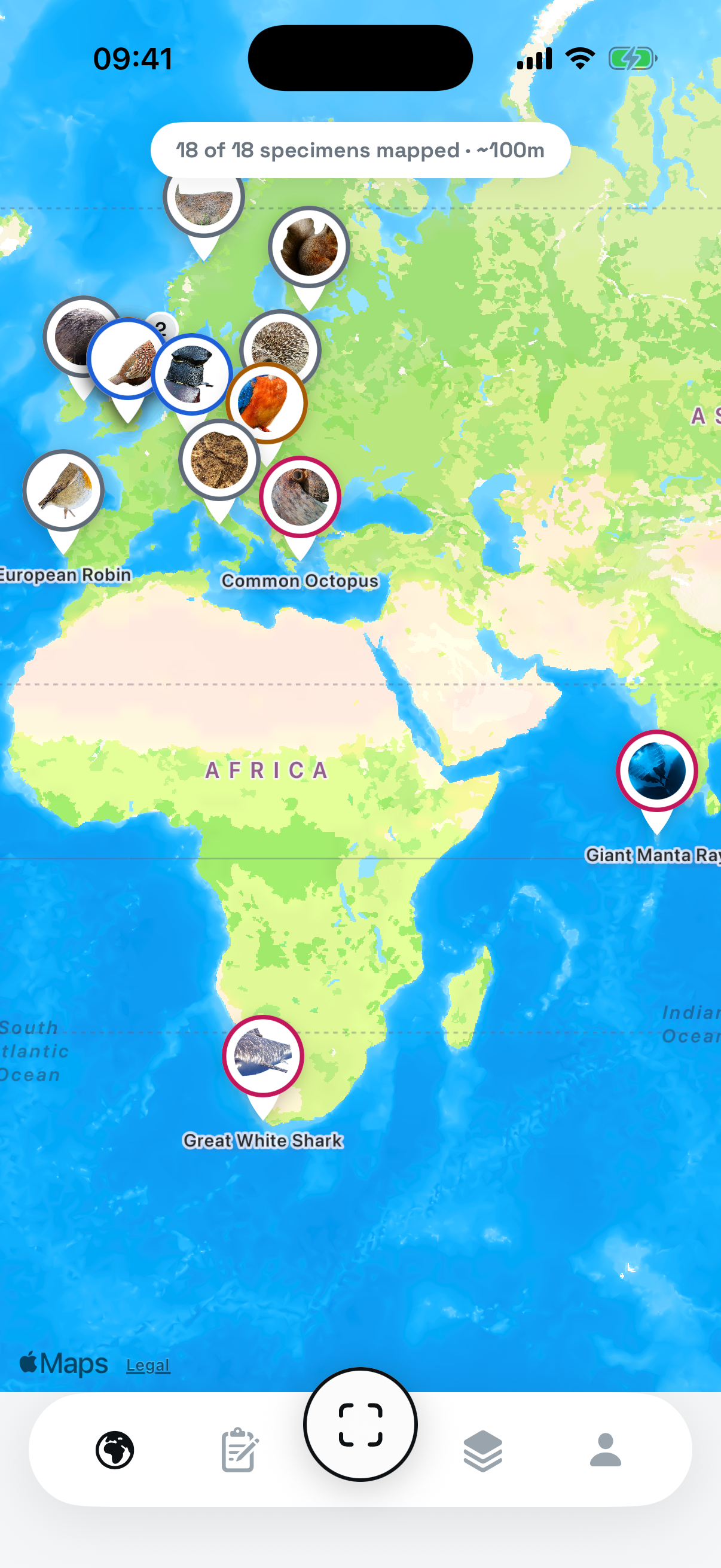
Every specimen drops a marker where you logged it, coloured by what you found. Scroll back over a summer and the sector map reads like a diary.

  • Clustered by classification. The colour of a cluster tells you the best thing inside it before you open it.
  • Approximate on purpose. Coordinates are logged to roughly a hundred metres, and other agents only ever see your territory. The mainframe does not require your exact position, and frankly isn't interested.
  • Directives read from it. "Log in three places" and "log in three territories" are answered straight off the map.
The sector map: cut-out animal markers standing where each specimen was logged, ringed in their classification colours

05 — THE DIRECTIVES

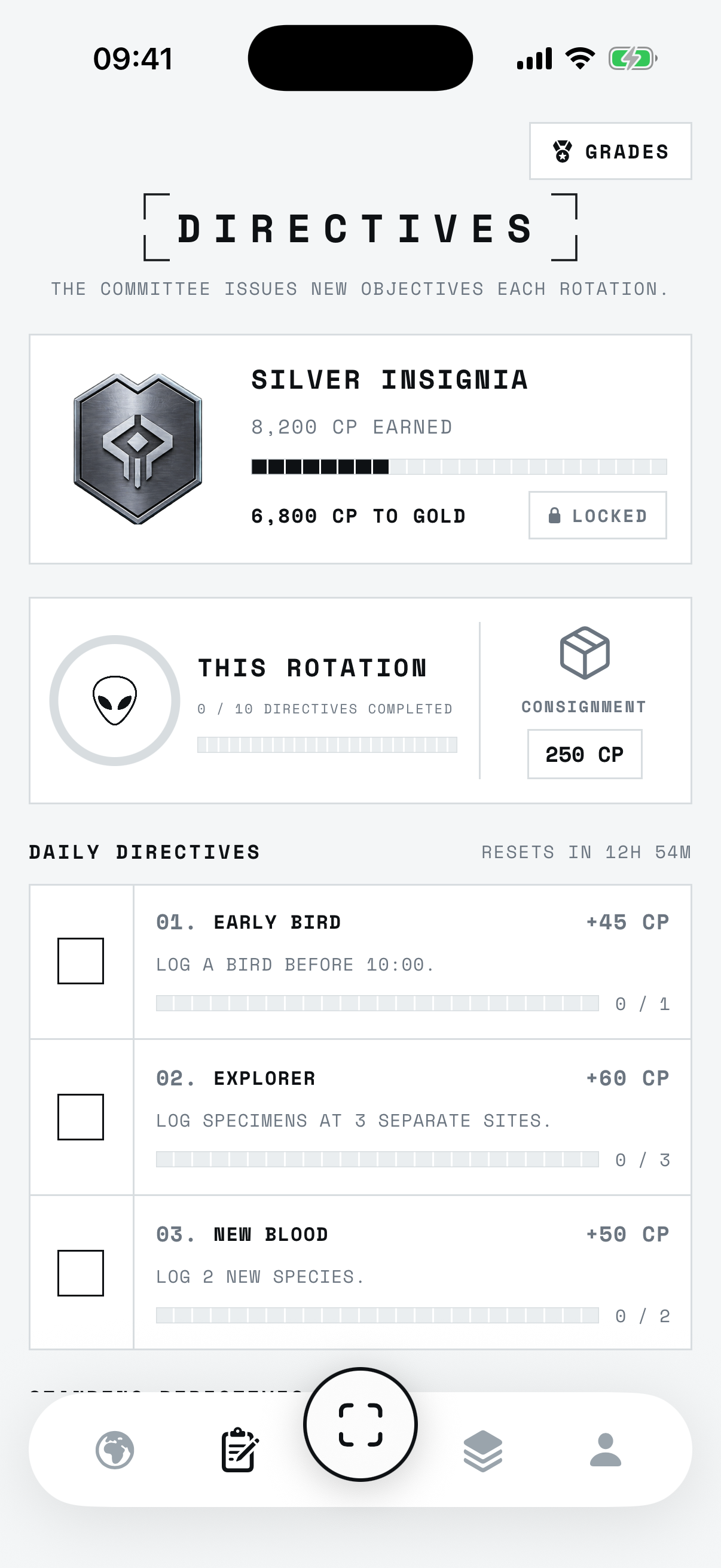
The committee issues new objectives each rotation.

Three fresh daily directives, a rotating long-term set, and a weekly crate for clearing ten. All of it pays Commendation Points, which build toward insignia. Completion is technically optional.

  • Dailies reset every rotation. Big game, Wanderer, Quick five — small asks, an evening each.
  • Long-term objectives. Log 25 species you've never logged. Log in three different territories.
  • Commendation Points only ever go up. There is no shop and nothing to spend them on. Their single job is the insignia ladder.
The directives screen, showing the insignia track and the rotation's daily objectives

06 — THE RANKING

Every agent starts again on Monday.

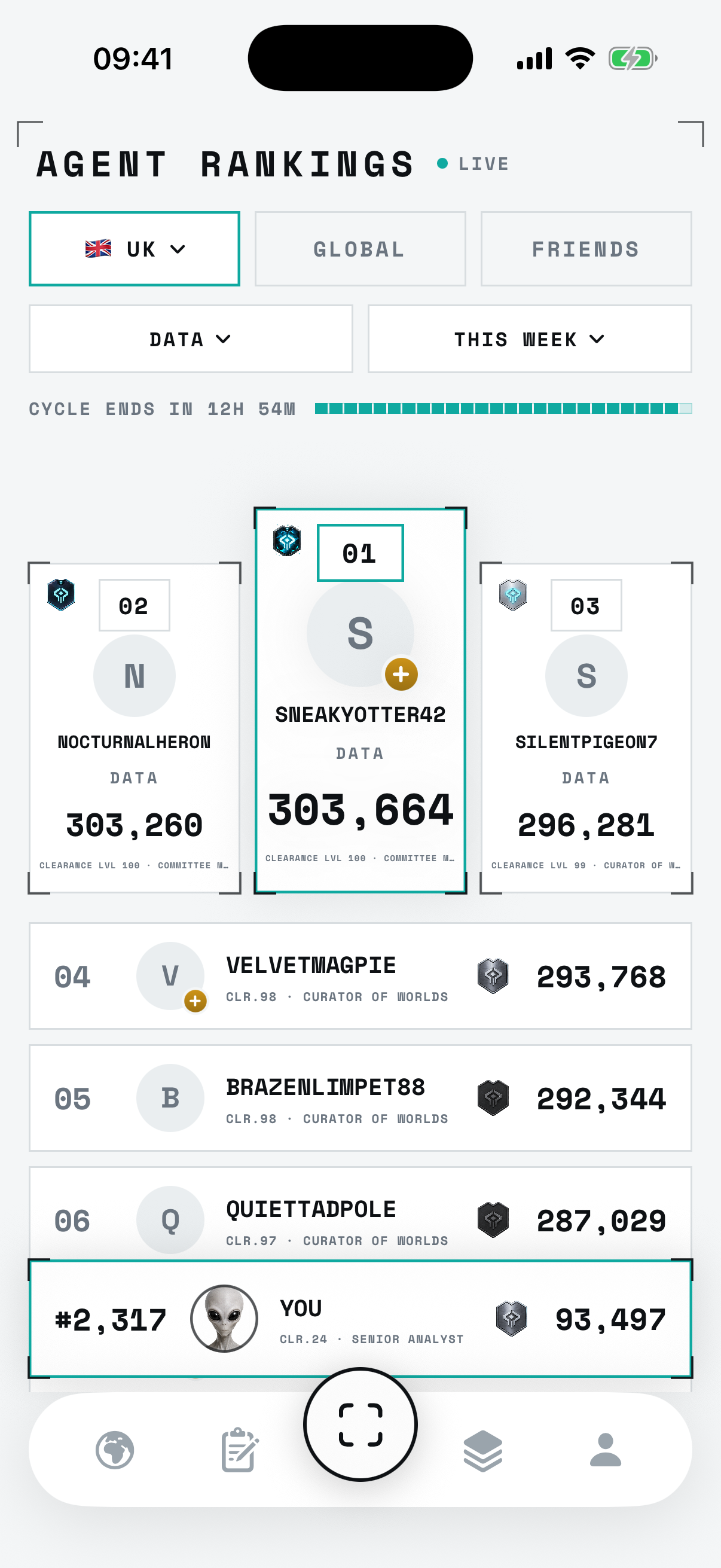
The ranking orders agents by DATA earned since the rotation began — in your territory, across the planet, or among the agents you know. The all-time board never forgets.

  • Your territory by default. Being 14th in the United Kingdom is a real position; being 40,000th on Earth is not.
  • You are always pinned. Your own row sticks to the bottom of the board wherever you actually sit.
  • Clearance and insignia show. Every row carries the agent's grade, so you can see what you're up against.
Agent rankings for the United Kingdom: a podium of agents wearing their chosen forms, the reader's own row pinned below

07 — THE AGENT FILE

Everything on record about you.

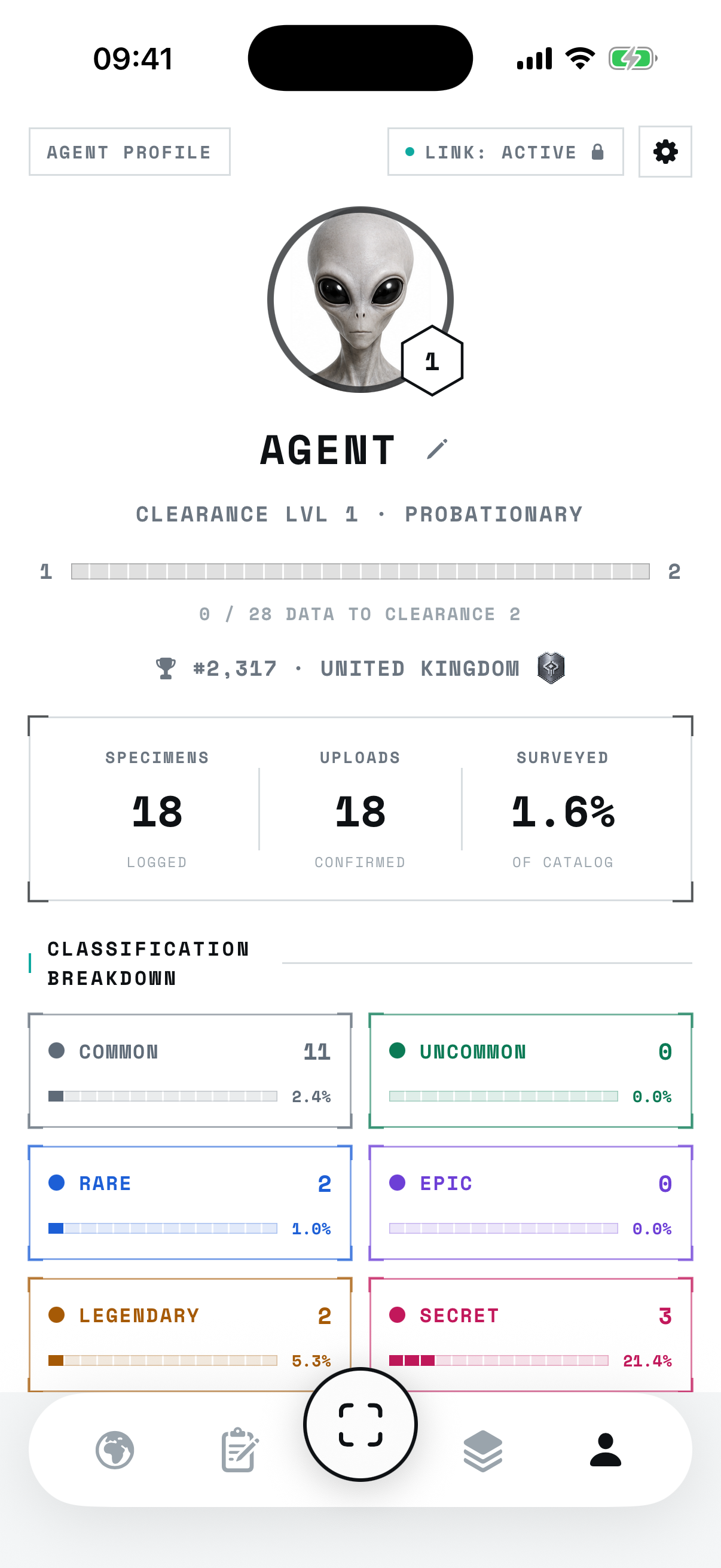
Your file is the honest summary: specimens logged, uploads confirmed, how much of the catalogue you have surveyed, and exactly which corners of the animal kingdom you have been neglecting.

  • Broken down by classification. A pile of Commons is a very different file from a single Secret.
  • And by kind. Mammals, birds, reptiles, amphibians, fish, insects, arachnids, molluscs — see where the gaps are.
  • Designated on day one. You are issued a codename the moment you enlist. Change it whenever.
The agent profile: clearance level, specimens logged, uploads confirmed and a classification breakdown

HOW YOU ARE ASSESSED

Three tracks. None of them buys another.

Most games funnel everything into one number you can grind. The Survey keeps three separate records, because they measure genuinely different things.

TRACK 01

DATA

Earned by logging specimens, and by nothing else. Rarer classifications pay more. This is what the ranking orders you on, and what raises your clearance.

WEEKLY · RESETS EACH ROTATION
TRACK 02

Commendation Points

Earned by directives, and by nothing else. Never spent, never lost, never shown on the ranking. Their only job is the insignia ladder.

LIFETIME · ONLY GOES UP
TRACK 03

Survey grade

Simply how much of the planet you have on file. It cannot be bought and it cannot be rushed. It rates the survey, not the agent.

SPECIES COUNT · 25 GRADES

They never convert. No amount of scanning buys an insignia, and no number of directives moves you up the ranking. Each has to be earned in its own currency.

SURVEY GRADE

From a trace of a biosphere to a total census.

Twenty-five grades, earned only by logging species you have never logged before. The gaps widen in threes, so the next grade stays visible without ever becoming cheap. The last one is the entire catalogue.

Trace1 SPECIES
Sample10
Fragment20
Partial Survey30
Field Survey50
Deep Survey90
Regional Census120
Working Archive260
Full Archive350
Codex510
Planetary Record840
Total CensusALL 1,135

CLEARANCE — RAISED BY LIFETIME DATA

A second ladder runs alongside it, thirty-five grades deep: Probationary, Trainee, Cadet, Observer, Recorder, Cataloguer, Field Agent, Surveyor, Xenobiologist, Analyst, Inspector, Director, Commissioner, Chancellor, Overseer, Archivist Prime, Curator of Worlds. One says how far you have got; the other says what the Survey has, because of you.

INSIGNIA — EARNED WITH COMMENDATION POINTS

Bronze

1,000 CP

Silver

5,000 CP

Gold

15,000 CP

Platinum

40,000 CP

Diamond

100,000 CP

LINK: ACTIVE

Go outside. Come back with something on file.

Xenolog is out now on the App Store — free, for iPhone on iOS 17 and up. Earth catalogue: incomplete.

Download on the App Store iPhone · iOS 17+ · free